
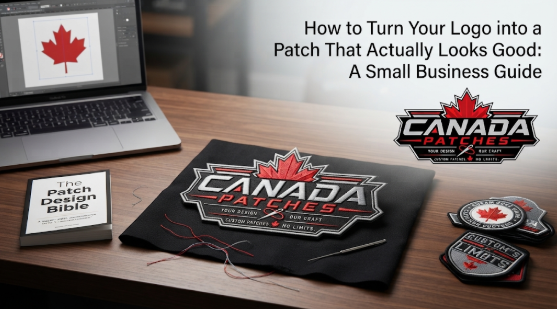

While a logo that is professionally presented on a website will appear just as professional on fabric, thin lines, small fonts, crowded images, and bad color choices will ruin a patch. In order to turn your logo into a patch that will successfully represent your company, it is important to adjust your logo to the medium, the size, the way it will be stitched, and how you will use it.
1. How to Turn Your Logo into a Patch Without Losing Important Details?
Begin by looking at your existing logo for any elements that will be hard to convert into embroidery or weave.
Ahead of production, make sure to have a file with your logo in high resolution, preferably vector-based (SVG, AI, or EPS). If you have only PNG or JPG, you should inquire if your supplier will be able to recreate your artwork for production.
When comparing premium custom logo patch makers, request a digital proof showing the proposed dimensions, thread colors, borders, and lettering. This helps you identify design problems before manufacturing begins.
2. Which Patch Material Works Best for Your Logo?
The proper choice of fabric will depend on the complexity of your artwork, the nature of the clothing, and the budget you have set. Embroidered patches have a raised look due to their texture, while woven patches can capture small details thanks to their thinner threads. Printed patches are best for artworks that include gradients, photos, and detailed color changes.
| Type of patch | Good for | Advantage | Disadvantage |
| Embroidered | Simple logos and shapes | Traditional look | Fine details may not show up well |
| Woven | Small letters and lines | More detail in small patches | Flat texture |
| Printed | Complex designs and gradients | Ability to change colors and details | Less traditional stitch design |
A good example could be using embroidery patches for a café with a cup-shaped logo, while technology companies with small lettering will appreciate the woven look. Make sure to look at the artwork in real size and not just a large digital version.
3. How Can You Make Your Patch Look Professional on Clothing?
Professional results depend on more than the artwork. The patch must remain readable, suit the garment, and withstand regular use.
For logo patches for uniforms, prioritize legibility, appropriate dimensions, and colors that contrast clearly with the fabric. A complicated logo may need a simplified version for shirt sleeves, while a larger jacket patch can accommodate more detail.
Follow these simple tips:
- Make your logo simpler: Cut back on unnecessary embellishments and refrain from making overly delicate lines.
- Pick appropriate fonts: Make the letters bigger or exclude additional text if there isn’t enough space.
- Choose contrasting colors: Make sure that the logo stands out on the fabric background.
- Pick proper borders: Merrowed borders fit well for most traditional designs, while laser-cut or heat-cut borders will help to add a more complicated contour.
- Correspond to the way of attachment: Sew-on backing is a reliable option in case of workwear being constantly laundered, while iron-on backing is more convenient when the fabric allows for that.
Request a sample if you have a big order or a complicated design.
See also: How to Manage a Job Search While Working
4. How Do You Choose a Reliable Manufacturing Partner?
The ideal supplier must take into account art preparation, production limitations, material choices, and quality assurance. The ideal supplier must also be characterized by clear communication, transparency on pricing, short lead times, and the proof approval process.
A Canada patches company may be worth considering when you want to discuss production requirements with a supplier serving Canadian businesses. However, confirm the actual manufacturing location, production arrangements, shipping costs, and delivery estimates instead of assuming that a Canadian-focused company manufactures every order domestically.
Before approving production, ask for confirmation of patch dimensions, backing, thread colors, minimum order quantity, sample availability, and replacement policies for defective products. These details help prevent unexpected costs and inconsistent results.
5. What Should Small Businesses Consider Before Ordering?
Getting the right amount and trying out the design would make it more cost-effective in the long run. Ask for a free sample or have the design digitally approved prior to mass production. If your business is expected to expand, you may want to keep the final design and production requirements for future orders.
Businesses looking into branded patches Canada services should also take into consideration how these patches will be used, like whether they will be placed on uniforms, giveaways, hats, bags, or even promotional items.
To Turn Your Logo into a Patch successfully, assess the design at its final size, confirm the material, and test the attachment method on the intended garment. These small checks can prevent costly production mistakes.
Ready to Create a Patch for Your Business?
Check out www.canadapatches.com to find out about the possibilities for custom patches and to discuss your design artwork, preferred materials, and manufacturing processes. Be sure to let us know what your logo is and how you will use it.
Frequently Asked Questions
Can any business logo be converted into a patch?
Adaptability is usually the norm for most logos, although complicated art might require some modifications. Good text, gradient, and thin lines usually need some modification to make them visible on the fabric.
What is the best patch type for a detailed logo?
Woven patches are often suitable for small lettering and fine lines. Printed patches may be preferable for gradients or photographic designs, while embroidery works well for bold, textured artwork.
How can I prevent my logo from looking crowded?
Choose an appropriate patch size, remove unnecessary details, improve spacing, and use readable lettering. Always review the design at its actual production dimensions.
Should I order a sample before bulk production?
Yes, especially if it is a big order or a new design. With the sample, you will be able to inspect the color match, stitching, legibility, backing, and overall quality.
Conclusion
An effective logo patch should have recognizable artwork, appropriate materials, visible elements, and quality manufacturing. By making your logo simpler, using the right construction process, examining a sample of the patch, and ensuring its high quality, you will be able to make patches for your company.
